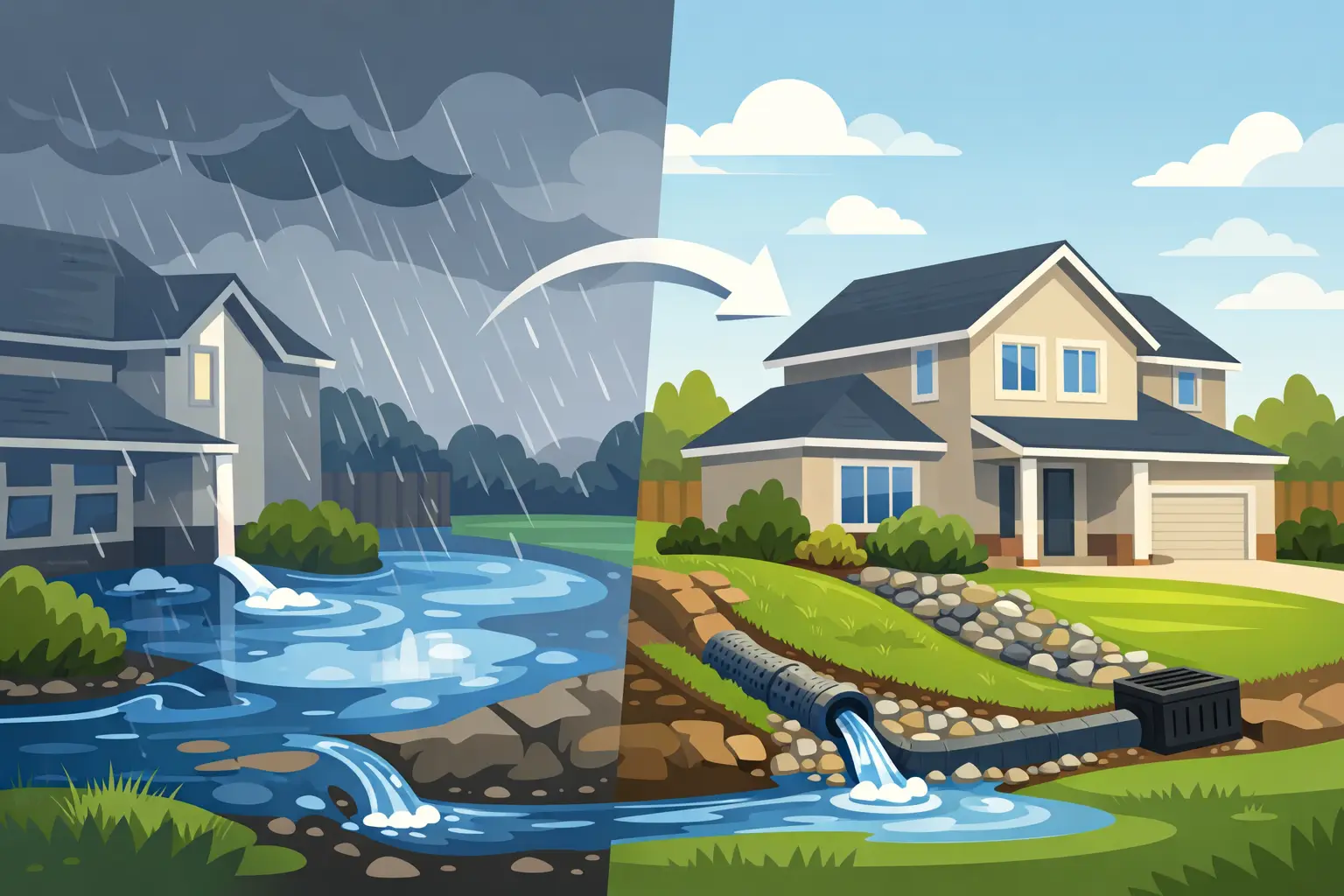
Drainage Correction After Heavy Rain for DFW Homes
August 24, 2026
A North Texas downpour can reveal more about your property in one afternoon than months of dry weather. If water pools beside the slab, rushes across a walkway, spills from clogged gutters, or leaves the yard soft for days, drainage correction after heavy rain should move to the top of your home-maintenance list. Water that stays where it does not belong can affect landscaping, concrete, crawl spaces, and eventually the foundation supporting your home.
For Dallas-Fort Worth homeowners, this is not only a surface-water issue. Our expansive clay soil changes volume as moisture levels rise and fall. When one side of a foundation stays wetter than another, uneven soil movement can contribute to settlement, heaving, cracks, sticking doors, and sloping floors. A properly planned drainage solution helps create more consistent moisture conditions around the structure.
Start With What the Rain Exposed
Do not judge the problem only after the ground has dried. Soon after a storm, walk the property safely and look for where the water traveled, where it stopped, and where it entered. A single puddle in a low spot may be a grading concern. Water collecting along the foundation wall or slab edge is more urgent because it can repeatedly saturate the supporting soil.
Pay attention to downspouts. Roof runoff carries a surprising amount of water, and a downspout that empties beside the house can create a concentrated wet zone even when the rest of the yard looks normal. Gutters that overflow, splash blocks that have shifted, and extensions pointed toward the foundation all deserve correction.
Inside, check for new or worsening signs after the storm. Damp carpet near exterior walls, musty odors, wet baseboards, water in a crawl space, or moisture at a garage threshold can point to a drainage path that is reaching the structure. Cracks and door problems do not always mean drainage is the sole cause, but they should be evaluated in context with the property’s water patterns.
When Drainage Correction After Heavy Rain Is Needed
The right response depends on the source of water. Adding a drain without identifying the source can simply move water from one troubled area to another. The goal is to collect, redirect, and discharge water to an appropriate location away from the foundation and neighboring properties.
Surface water that cannot leave the yard
Standing water in a swale, near a patio, at the base of a slope, or along a driveway often calls for a surface drain. These systems use catch basins or channel drains to collect water moving across the ground. They are especially useful where a hard surface directs runoff toward the home or where the yard’s natural low point sits too close to the structure.
A surface drain is not a cure for every wet yard. If the drain outlet has nowhere to discharge, the system may hold water rather than solve the problem. Proper slope, pipe sizing, outlet placement, and grading are what make the installation effective.
Water moving through saturated soil
A French drain is designed for a different condition. It collects water below the surface through a perforated pipe surrounded by drainage material, then carries it away. It can help where soil remains wet near the house, water collects below landscaping, or runoff travels underground toward a slab or crawl space.
French drains require careful planning. Their depth, location, filter fabric, gravel, pipe slope, and outlet all matter. In North Texas clay soils, a system should be designed around the property’s actual grades and moisture behavior rather than copied from a one-size-fits-all diagram.
Roof runoff concentrated at the foundation
Sometimes the larger drainage issue begins on the roof. Repairing gutters, cleaning debris, adjusting their pitch, and extending downspouts may be the most direct solution. Downspout water should be directed well away from the foundation through a suitable above-ground or buried route.
This is one reason an inspection matters. A homeowner may see pooling near the back corner and assume the yard needs extensive excavation, when the immediate cause is an overflowing gutter or short downspout. On the other hand, fixing the gutter alone may not be enough if the yard drains back toward the house.
Why Grading Still Matters
Drainage systems work best when the ground supports the plan. Soil immediately around the foundation should generally slope away from the home so ordinary rainfall does not settle against the slab. Over time, mulch, landscape borders, added soil, concrete flatwork, and erosion can change that slope.
Be cautious about simply piling soil against the house. Raising the grade too high can cover brick weep holes, siding clearances, or other features intended to manage moisture. It can also hide a problem without correcting where the water goes. Grading should improve drainage while maintaining proper clearance and a reliable route for runoff.
Landscaping choices matter as well. Dense edging, decorative rock, and raised beds can act like small dams when installed in the wrong location. A beautiful landscape should not trap roof runoff beside the foundation. Before changing beds or hardscape, consider how water will move during the next hard rain, not only how the area looks on a dry day.
Protect the Foundation From Moisture Swings
Foundation protection in DFW is about balance. Constantly saturated soil can be harmful, but extreme drying can also cause expansive clay to shrink. The objective is not to make the soil bone dry. It is to prevent large, uneven moisture changes around the home.
After drainage improvements, maintain the system. Keep gutters clear, check downspout outlets, remove leaves from surface-drain grates, and watch for erosion around discharge areas. During prolonged dry periods, follow a sensible foundation watering approach if recommended for your property. Consistency is more valuable than reacting only when a crack appears.
If you already have foundation symptoms, do not assume a drain will reverse structural movement on its own. Drainage correction can reduce a major contributing factor and protect completed repairs, but existing damage may require foundation repair, house leveling, or additional evaluation. A clear inspection should explain what drainage can address, what it cannot, and why.
Avoid Quick Fixes That Create Bigger Problems
After a storm, it is tempting to buy a few bags of soil, cut a trench, or send water toward the fence line as quickly as possible. Small maintenance steps can help, but rushed drainage work can cause problems for the home and for surrounding properties.
Avoid routing concentrated runoff toward a neighbor’s lot, across sidewalks where it can create hazards, or into an area that has no outlet. Do not connect drainage to plumbing systems without confirming local requirements and the system’s intended use. Also avoid digging near utilities or foundation elements without a plan.
A temporary surface pump may be appropriate for an active emergency, but it is not a long-term answer for recurring water. If the same area floods after multiple storms, the property needs a permanent drainage path designed for its layout.
What a Professional Drainage Evaluation Should Cover
A useful evaluation looks beyond the puddle. The contractor should assess roof runoff, existing gutters and downspouts, soil slope, paving, landscape features, low areas, drainage outlets, and signs of foundation movement. The best recommendation may be a French drain, a surface drain, grading adjustments, downspout work, or a combination of measures.
Ask where collected water will discharge and how the system will be maintained. Ask whether the plan protects the foundation without creating a new issue at the patio, driveway, fence, or neighboring property. You should also receive a straightforward explanation of the work scope and the reason each part is recommended.
All American Foundation Repair & Drainage has served North Texas property owners since 1969, with solutions built around local soil conditions and the specific water patterns at each home. A free estimate can help separate a minor runoff correction from a problem that needs a more complete drainage and foundation-protection plan.
The next heavy rain does not have to become another source of anxiety. Take note of what the water is telling you, correct small issues before they grow, and bring in experienced help when runoff is reaching the foundation or returning storm after storm.