How to Fix Yard Ponding Before It Harms Your Home
November 17, 2026
A puddle that remains in your yard long after a North Texas rainstorm is more than a landscaping annoyance. Knowing how to fix yard ponding can help protect your lawn, reduce mosquito activity, and keep excess moisture from working its way toward your home’s foundation.
In the Dallas-Fort Worth area, drainage problems often become foundation concerns because expansive clay soils react strongly to changes in moisture. When one portion of the soil around a home stays wet while another dries out, the ground can swell and shrink unevenly. Over time, that movement can contribute to cracking, sticking doors, uneven floors, and other signs of structural stress.
The right repair depends on why water is collecting, where it is collecting, and where it can safely go next. The goal is not simply to move water away from one low spot. It is to create a controlled drainage plan that protects the entire property.
Start by Finding the Cause of Yard Ponding
Ponding happens when water reaches a low area faster than the soil, grass, or drainage system can handle it. Sometimes the cause is obvious, such as a downspout dumping roof runoff into one corner of the yard. Other times, it takes a closer look at how the lot was graded, how the soil has settled, and whether nearby hard surfaces are directing water toward the house.
Walk the property during a moderate rain if it is safe to do so. Notice where water begins to collect, how it travels across the yard, and how close it gets to the foundation. Check again 24 to 48 hours later. A shallow puddle that disappears quickly may be normal after a heavy storm. Water that remains for several days needs attention.
Common causes include compacted clay soil, settlement near the home, clogged gutters, short downspouts, poor grading, blocked swales, irrigation overspray, and landscaping features that unintentionally act like dams. A broken underground water line can also create wet ground when it has not rained, so do not assume every wet area is a stormwater problem.
How to Fix Yard Ponding With Better Surface Drainage
Surface drainage is often the best starting point when the problem is broad, visible, and caused by rainwater flowing across the yard. The principle is simple: establish a gentle path that carries water away from the home and toward an approved discharge area.
Correct low spots with proper grading
A low spot in the lawn can often be improved by adding and compacting suitable fill, then restoring the final grade with topsoil and sod. The finished surface should slope away from the house rather than flattening out near the foundation.
As a general rule, the ground should fall about 6 inches over the first 10 feet away from the home where site conditions allow. That does not mean every yard needs to look steep or uneven. A qualified drainage professional can shape a gradual slope that looks natural while directing water where it belongs.
Be careful with quick fixes that pile soil against brick, siding, or foundation vents. Raising the grade too high can create a different moisture problem, hide weep holes, or allow water to bridge areas that should remain exposed. Grading needs to account for the home’s construction, not just the appearance of the lawn.
Keep roof runoff moving away from the foundation
One roof can shed thousands of gallons of water during a strong storm. If gutters are clogged or downspouts release water beside the house, that volume can saturate a small area of soil in a hurry.
Clean gutters regularly, repair loose sections, and make sure each downspout carries water well away from the foundation. Above-ground extensions can help in some situations, but they can be inconvenient to mow around and may not solve a severe drainage problem. Buried downspout extensions are often a cleaner long-term option when they discharge to a safe location and have adequate slope.
Restore swales and drainage paths
A swale is a shallow, gently sloped channel designed to guide stormwater across a property. Many homeowners do not realize their yard already has one until landscaping, fencing, mulch, or years of settling interrupt its path.
Do not fill a swale because it looks like a dip in the yard. That dip may be serving an important drainage purpose. If it has eroded, become blocked, or settled in the wrong direction, it may need to be reshaped so water can continue moving away from the structure without being redirected onto a neighbor’s property.
When a French Drain Is the Better Answer
Surface grading cannot solve every drainage issue. If water collects because the soil remains saturated below the surface, or if runoff repeatedly reaches the same problem area, a French drain may be appropriate.
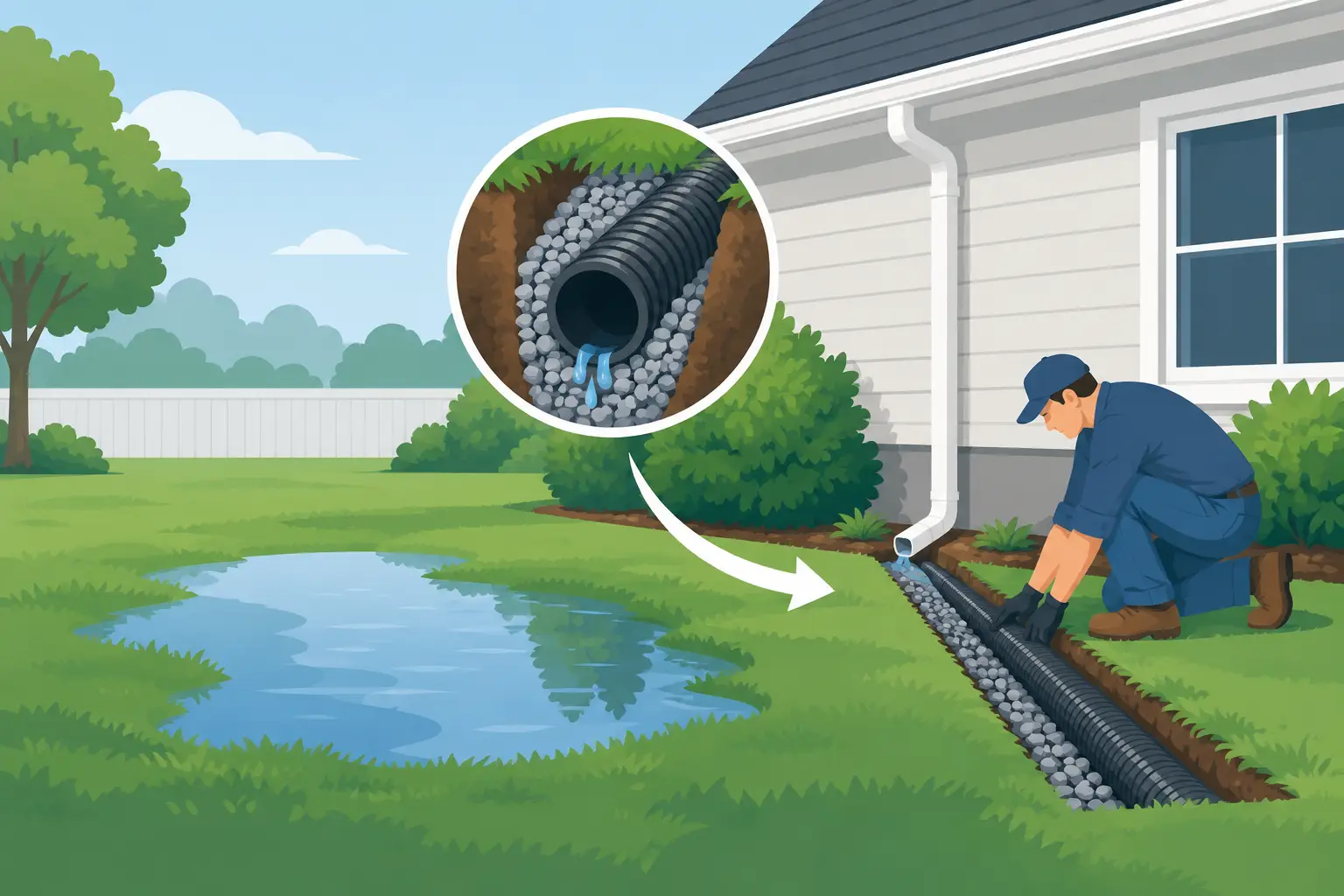
A French drain uses a perforated pipe surrounded by drainage rock and filter fabric. Water enters the system through the rock, moves into the pipe, and is carried to a planned outlet. It is especially useful along retaining walls, beside driveways, in chronically wet landscape beds, or in areas where water is moving through the soil toward the foundation.
A French drain is not a universal cure. It must be installed at the correct depth, with enough slope, clean gravel, proper fabric, and a reliable place for the water to discharge. A pipe installed without an outlet can become an underground storage tube. A system placed too close to a foundation or at the wrong elevation can fail to address the real source of water.
For visible standing water in a low area, a catch basin and solid drain line may be more effective than a French drain. The basin collects water at the surface, while the pipe carries it away. In many properties, the best solution combines surface grading, downspout routing, and a targeted drainage system rather than relying on one repair alone.
Do Not Send Water Somewhere It Will Cause Another Problem
Every drainage plan needs an endpoint. Water may be directed toward a suitable swale, approved drainage easement, curb connection where permitted, or another safe outlet based on the property layout and local requirements.
What should not happen is moving water from your yard directly into a neighbor’s yard, against a fence line with nowhere to go, or into an area that drains back toward the house. Water also should not be discharged near a slab edge, pier-and-beam crawlspace, or retaining wall.
This is where local experience matters. North Texas lots vary widely. A plan that works on a large, gently sloped property may not work on a tight lot in Duncanville or an older neighborhood where homes, fences, driveways, and easements limit drainage routes.
Protect the Foundation While You Correct the Yard
Until a permanent repair is completed, keep the moisture around the foundation as even as possible. Clear gutters, extend downspouts temporarily if needed, and avoid overwatering the lawn near the house. If an irrigation zone is soaking the same area every day, adjust the schedule and inspect for damaged heads or lines.
Do not ignore the opposite side of the home. In DFW clay soils, a foundation can be affected by both too much water in one area and overly dry soil in another. The objective is balanced moisture and controlled runoff, not a constantly wet perimeter.
Watch for changes inside the home as well. New or widening wall cracks, doors that suddenly stick, gaps at trim, sloping floors, and cracks in exterior brick may indicate that drainage is already affecting the structure. These signs do not automatically mean major foundation repair is needed, but they do justify a professional inspection.
When to Call a Drainage and Foundation Professional
A homeowner can handle routine gutter cleaning, minor downspout adjustments, and small lawn depressions. It is time to bring in a professional when ponding repeatedly returns, water stands near the foundation, the yard has no obvious outlet, or structural symptoms are present.
A thorough evaluation should look beyond the puddle itself. The inspector should consider roof runoff, grading, soil conditions, irrigation, existing drains, hardscape, foundation type, and the safest discharge route. That allows the repair plan to address the cause instead of treating the same wet spot after every storm.
All American Foundation Repair & Drainage has worked with North Texas soil and drainage conditions for decades. A clear, site-specific recommendation can help you decide whether the property needs regrading, a surface drain, a French drain, downspout extensions, foundation evaluation, or a combination of solutions.
Standing water rarely improves on its own. Addressing it early gives you more options, helps preserve your yard, and provides a stronger layer of protection for the home you have worked hard to maintain.