Underpinning vs Slab Jacking: Which Repair Fits?
November 12, 2026
A floor that suddenly feels uneven or a crack that keeps reopening can make any property owner wonder how serious the problem has become. When comparing underpinning vs slab jacking, the right answer depends on more than whether a slab needs to be lifted. It depends on why the movement happened, whether the structure still needs long-term support, and how North Texas soil and drainage are affecting the property.
Slab jacking and underpinning can both address settlement, but they do very different jobs. One fills voids and raises concrete in selected situations. The other transfers the weight of a structure to deeper, more dependable bearing material. Choosing the less invasive option when a home needs structural support can delay the real repair. Choosing extensive structural work for a stable, localized slab issue can be unnecessary.
Underpinning vs Slab Jacking: The Key Difference
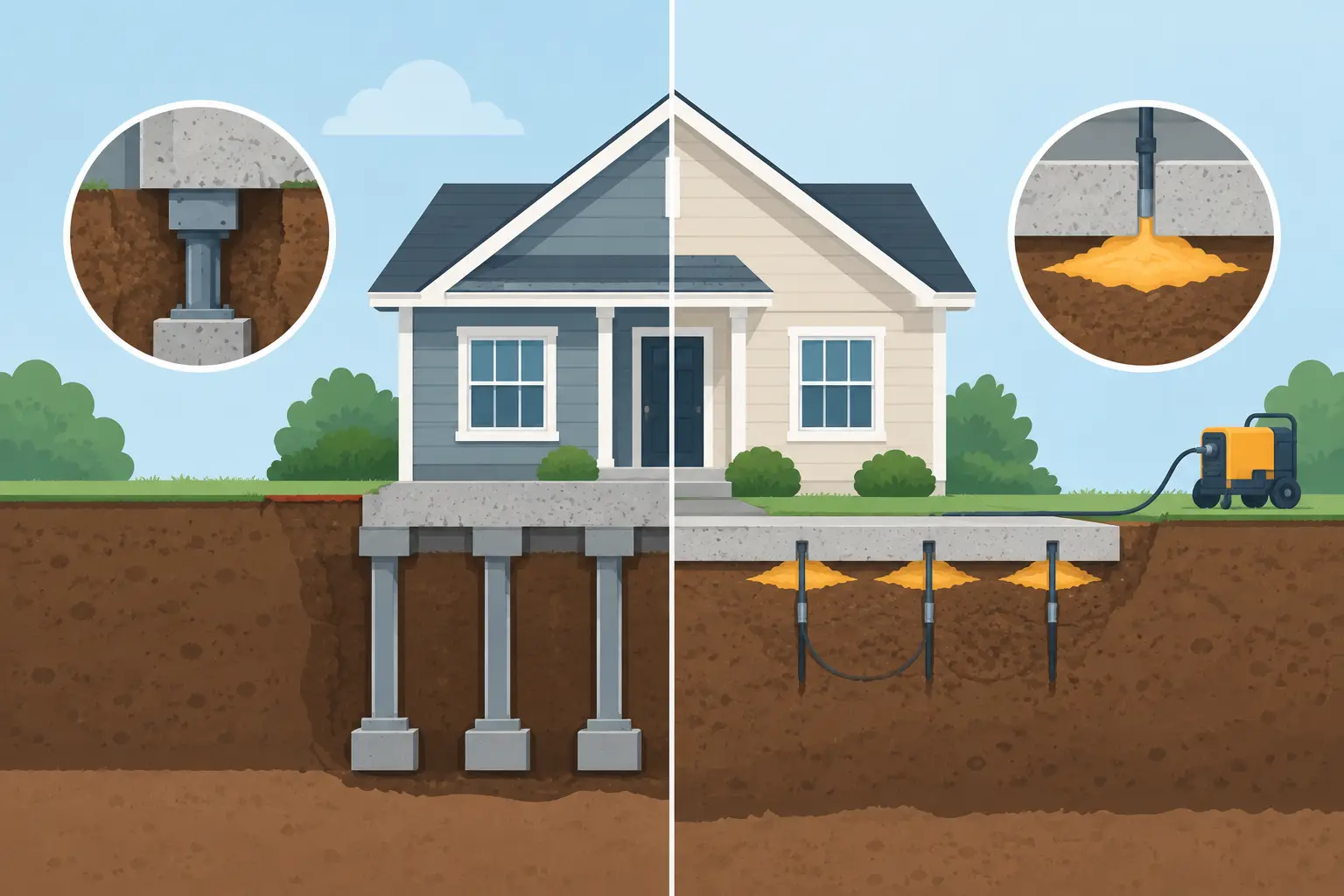
Underpinning is a structural foundation repair method. It strengthens or stabilizes an existing foundation by adding support beneath it, commonly through piers installed at engineered locations. For many Dallas-Fort Worth slab homes, this may involve concrete or steel piers driven or installed to reach more stable soil below the active clay zone. The foundation is then supported by those piers, and affected areas may be carefully lifted when conditions allow.
Slab jacking, sometimes called mudjacking, is a concrete lifting method. Technicians drill small holes through a settled slab and pump a grout-like material beneath it. The material fills open spaces, bears against the underside of the concrete, and can lift the slab back toward its intended elevation. Modern versions may use polyurethane foam rather than cementitious grout.
The distinction matters: slab jacking primarily addresses the space below a concrete slab. Underpinning addresses the capacity of the foundation system to support the building over time.
A settled driveway, sidewalk, garage floor, or patio may be a good slab-jacking candidate. A home with ongoing differential movement, interior wall cracks, sticking doors, and separation at trim or brick often needs a closer structural evaluation before anyone recommends lifting it from below with injected material.
When Underpinning Is Usually the Better Choice
Underpinning is generally considered when the foundation has lost reliable support because of soil movement, poor bearing conditions, or long-term settlement. Expansive clay soils across the Metroplex shrink during dry periods and swell when moisture returns. That cycle can leave one section of a home moving differently from another.
Signs that may point toward structural support include cracks that widen over time, floors with noticeable slopes, doors or windows that bind, gaps around exterior trim, and brick cracking or separation. No single sign proves that underpinning is necessary. However, several symptoms occurring together deserve a professional foundation inspection.
It supports the home, not just the slab surface
The main benefit of underpinning is long-term load transfer. Properly placed piers are designed to carry the home’s weight past unstable upper soils to strata that can provide more consistent support. That is particularly valuable when a foundation has experienced continuing settlement or when a previous repair did not address the underlying cause.
Underpinning may also allow a controlled lift of settled portions of the structure. The goal is not always to force every crack closed or return every room to perfectly level. A responsible repair plan prioritizes stabilization and avoids creating new stress in framing, finishes, plumbing, or masonry. Some cosmetic repairs may still be needed after the foundation is stabilized.
Trade-offs to consider
Structural underpinning is usually more involved and more expensive than slab jacking. It requires careful access planning, excavation at pier locations, and a repair layout based on the property’s movement pattern. It is also not a substitute for managing water around the home. If roof runoff, negative grading, leaking plumbing, or poor drainage keeps saturating the soil, that moisture problem can continue to affect the property.
Still, for a home that truly needs additional structural support, pier-based underpinning is often the repair that protects the investment rather than simply improving the appearance of a settled area.
When Slab Jacking Can Make Sense
Slab jacking is often a practical solution for concrete that has settled because material washed out, soil compacted, or a void developed beneath the slab. It can be less disruptive than removing and repouring concrete, and it is frequently used for flatwork such as sidewalks, patios, pool decks, driveways, and some garage slabs.
The process is relatively direct. Small access holes are drilled, lifting material is injected in measured stages, and the contractor monitors the slab as it rises. Once the desired elevation is reached, the holes are patched. When the issue is localized and the underlying soils are otherwise stable, this can be an efficient repair.
Slab jacking has limits
A lifted slab is not automatically a stabilized foundation. If a void developed because water is repeatedly washing soil away, the source of that water must be corrected. If the slab is moving because expansive clay is cycling through wet and dry conditions, injected material may not stop future movement. And if the concrete is badly cracked, thin, or structurally compromised, lifting it may not restore its integrity.
Slab jacking can also create a misleading sense of security when it is used on a residential foundation that needs deeper support. Material injected beneath a slab does not perform the same function as piers bearing the weight of a house. That does not make slab jacking a poor method. It makes it a method that must be matched to the problem.
How Dallas-Fort Worth Soil and Water Affect the Decision
In North Texas, foundation repair and drainage often belong in the same conversation. The region’s clay soils can change volume dramatically as moisture levels change. Extended dry weather can cause soils to pull away from a foundation. Heavy rain, irrigation problems, and roof runoff can then concentrate water in the same areas.
This back-and-forth movement is why an inspection should look beyond visible cracks. A qualified evaluation should consider soil conditions, site grading, gutter discharge, surface drainage, plumbing concerns, vegetation, and the pattern of movement throughout the structure. The best repair plan explains what is happening, what needs to be corrected now, and what should be monitored later.
For example, a patio that settled away from the home may need slab jacking and improved drainage. A home with settlement along one exterior wall may need underpinning, along with a French drain or surface drain solution if water is collecting near that side of the foundation. The repair methods are not always competing choices. On some properties, structural support and water management work together.
Questions to Ask Before Approving Any Repair
Before selecting a contractor or repair method, ask what evidence supports the recommendation. You should receive a clear explanation of the movement pattern, the proposed repair locations, and whether the work is meant to lift, stabilize, fill voids, improve drainage, or accomplish several of those goals.
It is also reasonable to ask how the contractor will protect landscaping and utilities, what disruptions to expect, whether cosmetic cracking may remain, and what warranty applies to the completed work. Be cautious with any recommendation that promises a one-size-fits-all fix without evaluating the specific home and site conditions.
Price matters, especially when foundation repairs are unexpected. But the lowest initial estimate is not always the lowest cost over the life of the home. A repair that addresses the cause of movement and includes a clear workmanship and warranty commitment can prevent repeated work later.
Choose the Repair That Protects the Property
The practical question is not simply whether underpinning or slab jacking costs less. It is whether the method solves the problem your property actually has. Slab jacking can be an excellent answer for settled, nonstructural concrete and localized voids. Underpinning is designed for foundations that need lasting structural support.
If you are seeing foundation warning signs in Dallas-Fort Worth, start with a thorough evaluation instead of guessing from a crack or uneven floor alone. All American Foundation Repair & Drainage can help property owners understand the condition of their foundation, the role drainage may be playing, and the repair path that offers the most dependable protection for the years ahead.