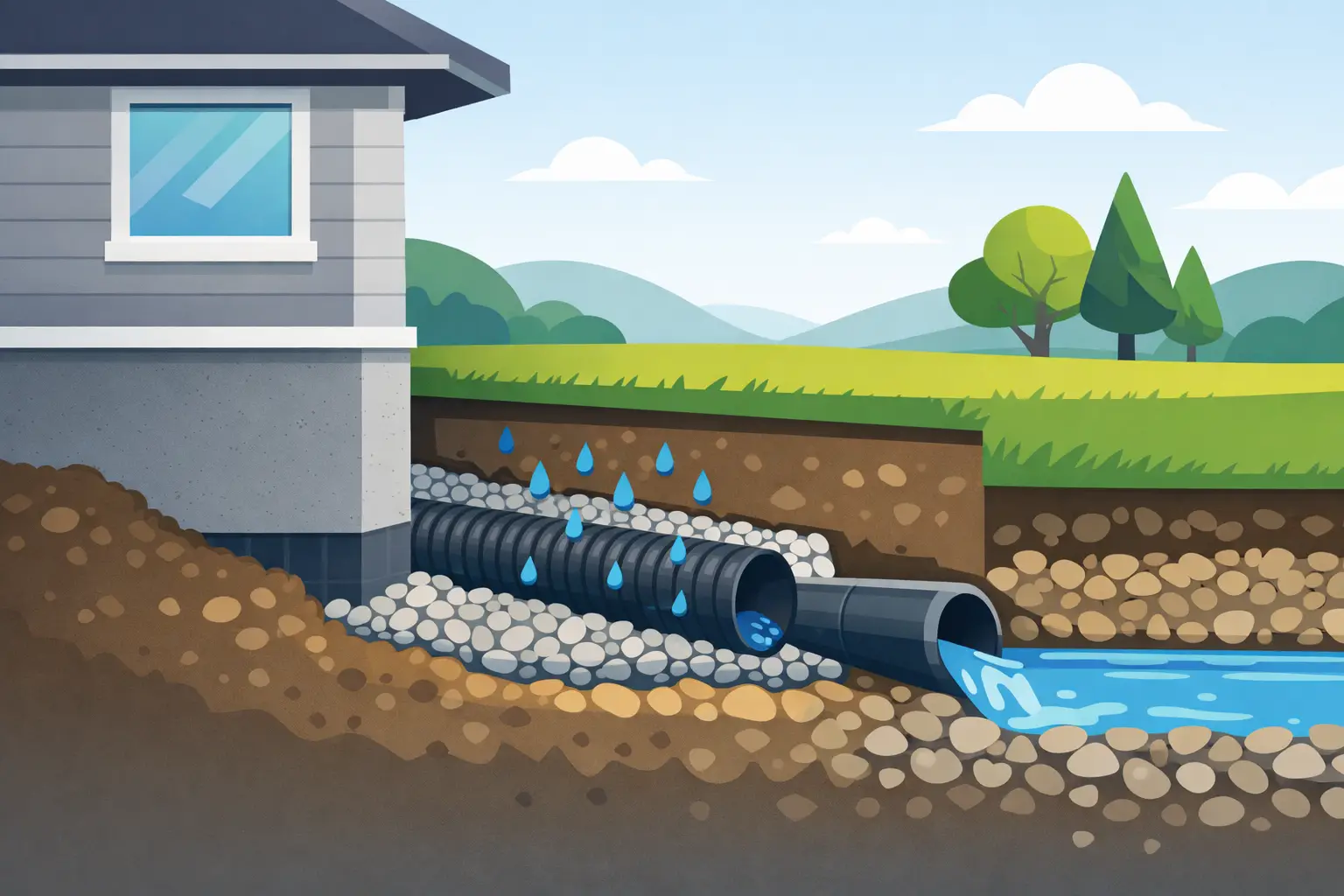
French Drain for Foundation Protection
June 18, 2026
Water usually tells on itself before foundation damage becomes obvious. You may see puddles that sit too long near the house, mulch washing out after a storm, or soil pulling away from the slab in one season and swelling against it in the next. In North Texas, those shifts matter. A french drain for foundation protection can help control how water moves around your home and reduce the moisture swings that put stress on the structure.
For homeowners in Dallas-Fort Worth, drainage is not a cosmetic issue. It is directly tied to foundation performance. Expansive clay soils common in this region react strongly to moisture changes. When part of the soil around a foundation gets too wet while another area stays dry, the result can be uneven movement. That is when you start seeing cracks in walls, sticking doors, or floors that no longer feel level.
Why water control matters so much in North Texas
A foundation needs consistency more than anything else. That does not mean the soil must stay dry at all times. It means the moisture content around the home should stay as balanced as possible. When water repeatedly collects along one side of the house or near a corner, the soil in that area can expand. During hotter, drier periods, the same soil may shrink back.
That cycle of expansion and contraction is hard on both slab foundations and pier and beam systems. Drainage correction is often one of the most practical ways to limit future movement. In many cases, repairs hold up better when water is managed properly instead of being allowed to keep working against the structure.
What a french drain for foundation protection actually does
A French drain is designed to intercept and redirect excess water before it can build up around the foundation. In simple terms, it is a gravel-filled trench with a perforated pipe that collects water and carries it away to a safer discharge point. When designed correctly, it helps keep runoff and subsurface water from lingering where it can cause trouble.
The key word there is designed. A French drain is not just a trench with pipe dropped into it. The depth, slope, placement, soil conditions, and outlet location all affect how well it performs. If any of those are off, the drain may move too little water, clog early, or send water somewhere that creates a new problem.
For foundation protection, the goal is not to dry out the soil aggressively. The goal is to prevent damaging saturation and standing water next to the home. That distinction matters because overcorrecting can be just as unhelpful as doing nothing at all.
Signs your property may need a French drain
Some drainage issues are easy to spot, while others show up slowly through foundation symptoms. If water stands near the perimeter after rain, that is a clear warning sign. So is erosion along flower beds, wet areas that never seem to dry, or downspouts that dump too close to the house.
Inside the home, you may notice cracked sheetrock, doors that rub, windows that stick, or gaps opening at trim and molding. Those signs do not automatically mean drainage is the only issue, but they often point to moisture imbalance around the foundation.
A proper inspection helps separate surface runoff problems from deeper structural movement. In many cases, the right answer is a combination of foundation repair and drainage correction, not one or the other.
Where a French drain works best around a home
French drains are especially useful where water naturally collects and cannot move away fast enough on its own. That might be along the side yard, near a negative grade area, beside retaining features, or in sections where neighboring lots send runoff toward your house.
They can also be effective along portions of a foundation where repeated wetting has created unstable soil conditions. Still, placement should be deliberate. Installing a drain around the entire house is not always necessary, and on some properties, a surface drain or grading correction may solve the issue more directly.
That is why cookie-cutter drainage plans tend to miss the mark. Every lot has its own slope, hardscape layout, roof runoff pattern, and soil behavior. A system that protects one home well may be the wrong fit for the property next door.
French drain vs. surface drain for foundation protection
Homeowners often hear both terms and assume they are interchangeable. They are not. A French drain is typically used to collect water below the surface or within saturated soil zones. A surface drain is meant to capture water moving across the top of the ground, such as runoff from rain, gutters, patios, or driveways.
For many Dallas-Fort Worth homes, the best solution uses both. If roof water pours into one area and then soaks into the soil beside the slab, a surface collection system may handle the immediate runoff while a French drain helps relieve ongoing moisture buildup below grade.
The right choice depends on where the water starts, how it travels, and where it can safely discharge. Treating all water problems with one system can leave the main cause untouched.
Installation details that make or break performance
The difference between a drain that protects a foundation and one that becomes a buried problem comes down to workmanship. Proper slope is essential because water has to move consistently through the line. If the pipe runs flat or has low spots, sediment can collect and reduce flow.
The trench should be sized for the site conditions, and the pipe should be surrounded by the right drainage material. Filter fabric is often used to help reduce soil intrusion, especially in clay-heavy areas. The outlet must also be planned carefully. Redirecting water a short distance away from the home is not enough if the discharge area sends it back toward the structure or onto a neighboring property.
Clean transitions around landscaping, sidewalks, and existing features matter too. A drainage project should solve a structural concern without creating a maintenance headache in the yard.
Why foundation protection is about balance, not just drainage
This is where experience matters. In North Texas, too much water is a problem, but severe drying can also contribute to movement. A good drainage plan works to reduce extremes. It helps prevent pooling and oversaturation while supporting more uniform moisture conditions around the home.
That is one reason professional recommendations should be customized. A house with active settlement signs, large trees near the slab, and poor roof runoff control may need a broader plan than a simple trench drain. On another property, a targeted French drain may be exactly the right fix.
Homeowners sometimes hope for a single product that guarantees the foundation will never move again. Realistically, foundations respond to many factors, including rainfall patterns, soil type, grading, plumbing leaks, and vegetation. Drainage is one of the most important controllable factors, but it works best as part of a complete strategy.
When to act before damage gets worse
The best time to address drainage is before the next heavy season exposes the same weakness again. If you already know where water collects, waiting usually means giving that problem another chance to affect the soil around the foundation. Small cracks and minor sticking doors can turn into larger repair needs when moisture conditions stay uneven.
That does not mean every puddle calls for a major project. But if the same symptoms keep returning, or if your home shows both drainage and foundation warning signs, it is worth getting a professional evaluation. A straightforward inspection can tell you whether a French drain is appropriate, whether another drainage solution makes more sense, or whether structural repairs should come first.
For local property owners, that regional knowledge matters. All American Foundation Repair & Drainage, LLC has worked with North Texas soil and moisture conditions for decades, and that kind of experience helps when the goal is long-term protection, not a quick patch.
Choosing the right french drain for foundation protection
If you are comparing options, focus less on the sales pitch and more on the plan. Ask how the water will be captured, where it will discharge, how the slope will be maintained, and how the system fits your specific foundation type and lot conditions. A reliable contractor should be able to explain the reasoning in plain language.
You also want to know whether the drainage recommendation lines up with the structural symptoms you are seeing. If the house has movement, the drainage system should support foundation stability, not just improve the look of the yard after rain. Good contractors do not treat those as separate conversations.
A French drain is not glamorous work, but it can be some of the most important work you do for your property. When water is managed correctly, your foundation has a better chance to stay stable, your repairs have a better chance to last, and your home is better protected the next time North Texas weather turns against it.
If you are seeing water collect near your home, take it seriously early. The fix is usually simpler when the problem is still mostly in the yard and has not fully worked its way into the structure.