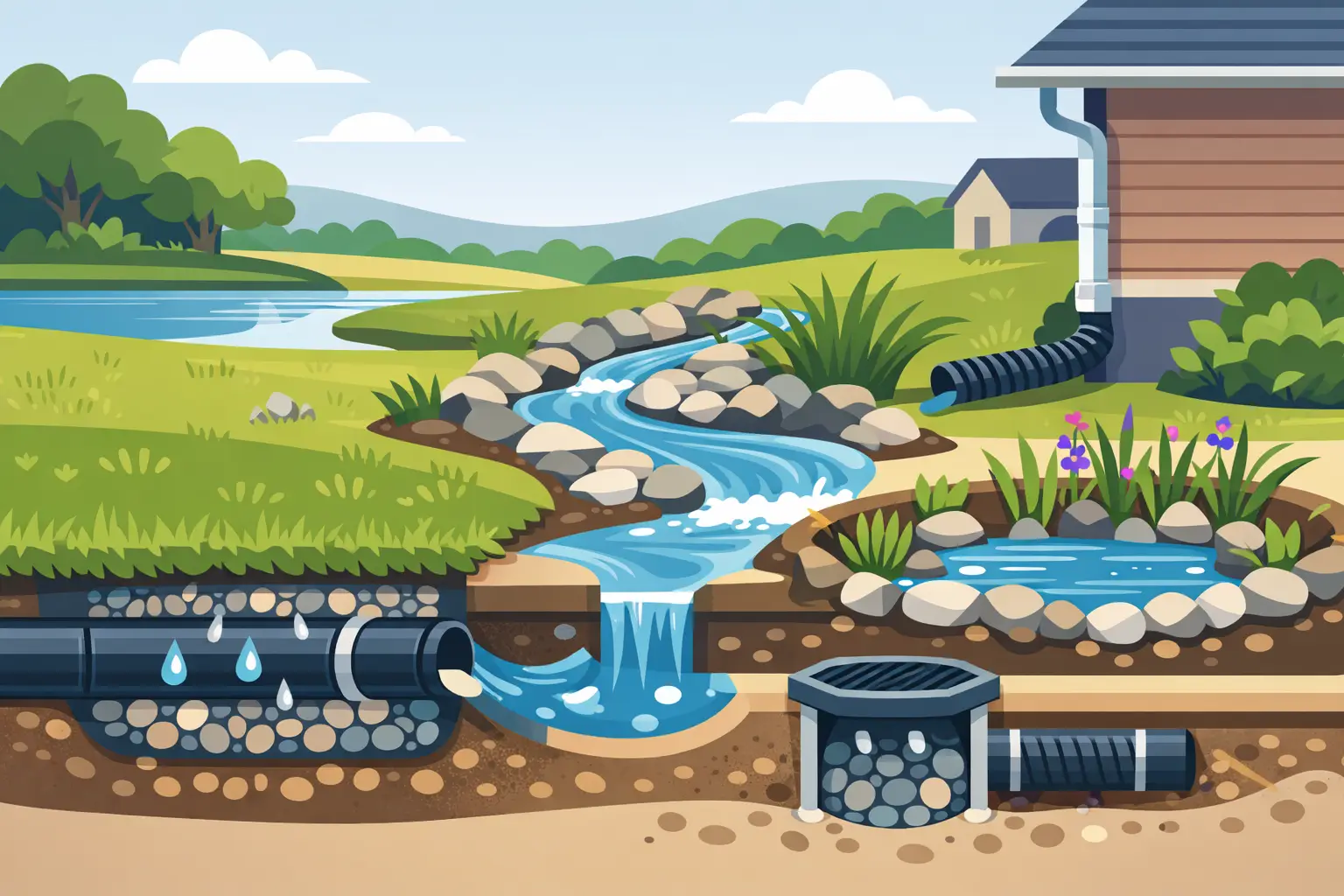
Best Drainage Solutions for Yards
July 9, 2026
A yard that stays soggy for days after rain is not just a landscaping nuisance. In North Texas, poor drainage can turn into standing water, dying grass, muddy low spots, and foundation stress faster than many homeowners expect. If you are looking for the best drainage solutions for yards, the right answer depends on how water moves across your property, where it collects, and how close that moisture stays to your foundation.
In the Dallas-Fort Worth area, drainage problems are closely tied to soil behavior. Expansive clay soils swell when they absorb water and shrink when they dry out. That constant movement puts pressure on slab foundations, pier and beam systems, and hardscape surfaces. A drainage fix that works well in one yard may fall short in another if the slope, soil, and runoff patterns are different. That is why the best approach starts with identifying the source of the water, not just the place where you see it pooling.
What makes the best drainage solutions for yards work
Effective yard drainage is about control. You want to move water away from the house, prevent ponding, and reduce oversaturation around the foundation. The best systems do that consistently, not just during a light shower but during the heavier storms that are common across DFW.
A good drainage solution should match the specific problem. Surface runoff calls for a different fix than groundwater saturation. Water coming off a roof may need collection and discharge, while water trapped in a low area may need regrading or a subsurface system. When homeowners try a one-size-fits-all fix, they often spend money twice.
There is also a long-term factor. Some drainage improvements are relatively simple and affordable, while others involve excavation, slope correction, or underground piping. The right investment depends on how serious the water problem is and whether it is already affecting your foundation, walkways, or structure.
Start with grading and slope correction
For many properties, the first and most important drainage improvement is proper grading. If the ground slopes toward the house, water will naturally collect near the foundation. That is where trouble begins.
Correct grading creates positive drainage, meaning water flows away from the home instead of back toward it. In many cases, this is one of the best drainage solutions for yards because it addresses the root of the problem. Water should not be given a chance to sit against the structure in the first place.
The trade-off is that grading has to be done carefully. If the slope is too shallow, the fix may not work. If it is too aggressive, you can create erosion or redirect water toward a neighbor’s property, fence line, or patio. On properties with limited elevation change, grading alone may not be enough, but it is still usually part of a complete plan.
French drains for persistent water buildup
A French drain is one of the most widely recommended drainage systems for a reason. It works well when water collects below the surface or along predictable paths in the yard. This system typically uses a gravel-filled trench with perforated pipe to collect and redirect water away from problem areas.
French drains are especially useful when you have recurring soggy zones, water near the foundation, or runoff moving through side yards. In DFW, they are often part of foundation protection because they help control moisture levels around the home.
That said, a French drain is not magic. It has to be installed at the proper depth and slope, and it needs a reliable outlet. If the trench is placed in the wrong spot or the discharge point is poorly planned, the system will underperform. Maintenance matters too. Over time, sediment and root intrusion can affect function if the system was not designed well from the start.
Surface drains and catch basins for fast-moving runoff
When water rushes across patios, driveways, or flat lawn areas during storms, a surface drain may be the better answer. Surface drains are designed to capture water at ground level and move it through solid piping to a safe discharge area.
Catch basins are often used in low spots where water naturally gathers. These systems are practical when you need to intercept runoff quickly before it spreads across the yard or works its way toward the house. They can be very effective around downspout discharge areas, concrete surfaces, and landscape transitions.
The key is proper placement. A catch basin in the wrong low spot may solve only part of the problem. Surface systems also need to stay clear of debris, leaves, and sediment. For homeowners, that usually means occasional cleaning to keep water flowing freely.
Downspout extensions often solve more than expected
Sometimes the drainage problem is not the yard itself. It is roof water being dumped too close to the house. During heavy rain, a roofing system moves a large volume of water in a short time. If downspouts release that water next to the foundation, you can end up with oversaturated soil, erosion, and settlement risk.
Extending downspouts away from the structure is one of the simplest and most cost-effective solutions available. On some homes, this small correction makes a noticeable difference right away. It is not unusual to see wet foundation beds, mulch washout, or standing water improve once roof runoff is moved farther out.
Still, extensions are not enough if the yard has deeper grading or drainage issues. They help manage concentrated water from the roof, but they do not correct a negative slope or a broad low area that traps runoff.
Swales and landscape drainage for larger yards
A swale is a shallow, sloped channel that guides water across the property in a controlled way. In larger yards or lots with natural slope, swales can be a smart solution because they manage runoff without relying entirely on underground systems.
This option works well when you need to move water away from the home and toward a safer drainage path. Swales can also be blended into the landscape more naturally than some hard drainage features, which matters for homeowners who want function without making the yard look heavily engineered.
The challenge is space. A swale needs enough room and the right contour to carry water effectively. On tighter suburban lots, especially where fences, patios, and neighboring properties limit your layout, a swale may need to be combined with drains or grading adjustments.
Dry creek beds and decorative drainage
For some homeowners, appearance matters almost as much as function. A dry creek bed can help channel surface water while improving the look of the landscape. These systems use stone-lined pathways to direct runoff through the yard.
They can be useful in areas with mild to moderate flow and are often chosen when erosion is part of the issue. A well-designed dry creek bed can reduce washout and keep water moving while fitting the style of the property.
The important thing to understand is that decorative drainage features still have to be engineered around how water actually behaves. If a dry creek bed is undersized or placed without enough slope, it may look good but fail during a real storm.
When drainage and foundation issues overlap
In North Texas, poor drainage and foundation movement often go hand in hand. If you are seeing cracks in brick, sticking doors, interior wall cracks, or uneven floors along with wet areas outside, the problem may be larger than yard drainage alone.
Too much water near the foundation can contribute to soil expansion. Then, when conditions dry out, the soil contracts. That cycle creates movement that can affect the structure over time. In those cases, the best drainage solutions for yards should be part of a broader property protection plan.
That is where a professional evaluation matters. An experienced local contractor can determine whether the right answer is grading, drains, foundation repair, or a combination of all three. Companies like All American Foundation Repair & Drainage, LLC have seen how quickly unmanaged water can turn into structural damage on DFW properties, and that local experience matters when the soil itself is part of the problem.
How to choose the right solution for your property
The best drainage system is the one that matches your yard’s actual conditions. If the issue is minor and isolated, a simple correction may be enough. If the problem shows up after every storm, affects multiple areas, or is already putting stress on the foundation, a more complete drainage design is usually the better investment.
Look at where water starts, where it travels, and where it ends up. Pay attention to whether the problem is coming from roof runoff, neighboring elevation, hard surfaces, or low grading around the home. Also consider how often the issue happens. A yard that struggles only during extreme storms is different from one that stays wet after ordinary rain.
The main goal is not just to remove water. It is to protect the stability of the home and create a drainage pattern that holds up over time. When water is controlled properly, you reduce the risk of foundation trouble, preserve the usability of the yard, and avoid repairs that get more expensive the longer they wait.
If your yard is holding water, the safest next step is not guessing. It is getting a clear look at what the property is doing and choosing a solution that fits the soil, slope, and structure you are trying to protect.