Expansive Clay Drainage Solutions for DFW Homes
July 28, 2026
A Dallas-Fort Worth foundation can move even when the house itself is well built. The reason is often beneath it: North Texas expansive clay soil changes volume as its moisture level changes. Effective expansive clay drainage solutions do more than move rainwater away after a storm. They help keep the soil around a foundation at a more consistent moisture level, reducing the repeated swelling and shrinking that can lead to cracks, sloping floors, and costly structural repairs.
For homeowners, the goal is not to make clay soil disappear. It is to manage water deliberately, correct the conditions that cause uneven soil movement, and protect the investment sitting above it.
Why Expansive Clay Creates Foundation Problems
Clay soils contain tiny, flat mineral particles that hold water. When those particles absorb moisture, the soil expands. During dry weather, especially through a long Texas summer, it contracts and can pull away from the foundation. That change can create voids or uneven support below a slab.
Some movement is normal in this region. Trouble begins when one section of soil becomes much wetter or drier than another. A roof valley that dumps water beside one corner of the home, a leaking plumbing line, poor grading, or a heavily watered flower bed can create concentrated moisture. Meanwhile, another side of the foundation may be drying out in direct sun.
That uneven moisture pattern can cause differential movement. In practical terms, one part of the foundation rises, drops, or shifts more than the rest. Homeowners may notice stair-step brick cracks, interior wall cracks, doors that stick, gaps around trim, or floors that no longer feel level. Drainage correction cannot repair every foundation issue on its own, but it is often a necessary part of stopping the conditions that contribute to continued movement.
Expansive Clay Drainage Solutions Start With the Water Source
A proper drainage plan begins with a careful inspection, not a one-size-fits-all recommendation. The visible puddle in the yard may be part of the problem, but the source can be farther uphill, higher on the roofline, or hidden underground.
The first question is where the water comes from. Roof runoff is a common culprit. Gutters that overflow, missing downspout extensions, and short discharge points can release hundreds of gallons near the foundation during a heavy rain. Surface water may also flow from a neighboring property, a driveway, a patio, or an improperly graded lawn.
The next question is where that water can safely go. A drainage system needs a suitable outlet, such as a lower area of the property, an approved discharge location, or a designed collection point. Sending water into the wrong area can trade one problem for another, saturating a different portion of the yard or affecting a neighbor’s property.
Finally, the inspection should consider the foundation’s current condition. If structural movement is already present, drainage needs to be coordinated with any recommended foundation repair. Correcting water flow protects the repair plan and helps reduce the chance of future moisture-related movement.
French Drains for Below-Grade Water Control
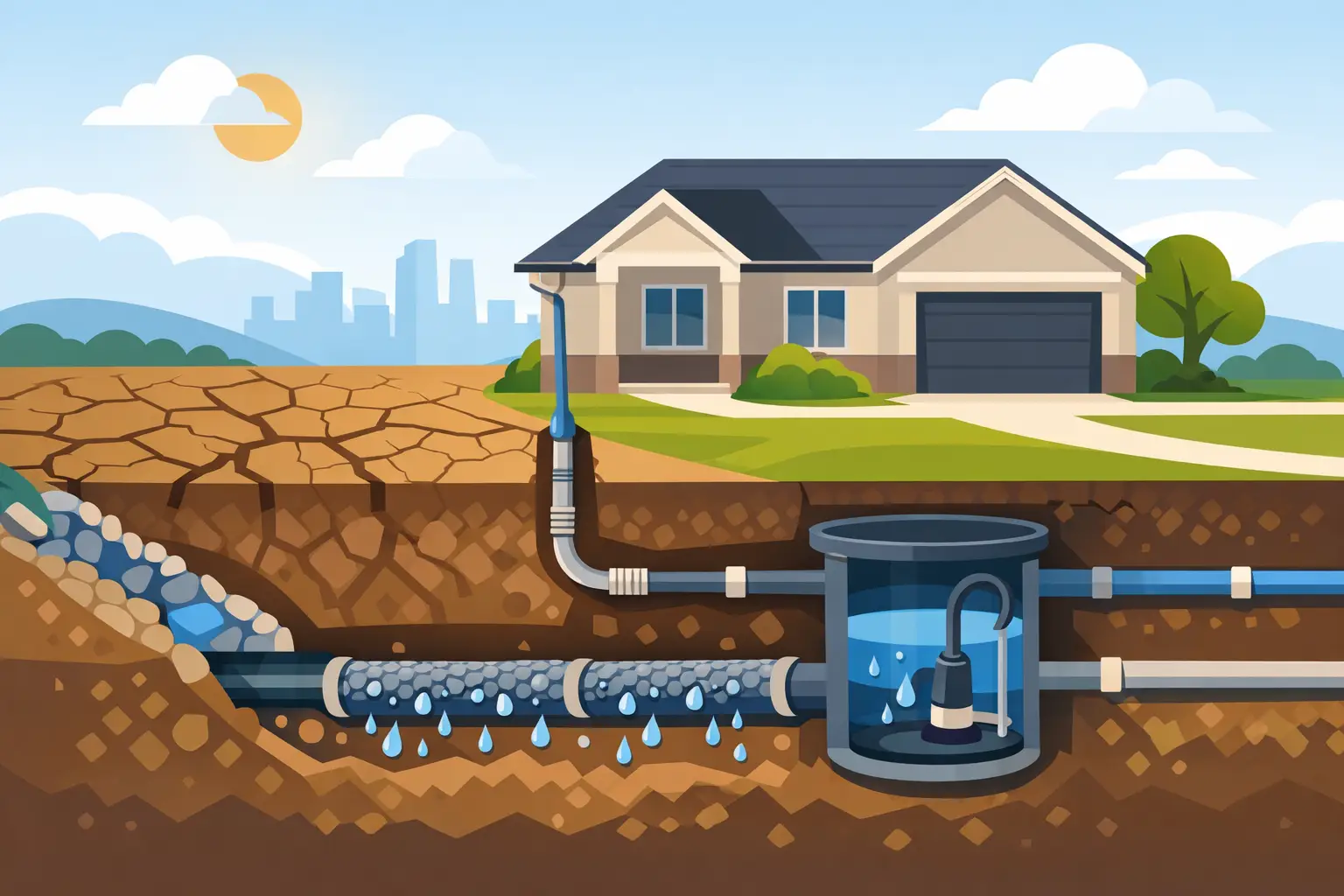
A French drain is designed to collect water below the surface. It typically uses a trench, permeable pipe, drainage rock, and filter fabric to capture water moving through the soil and carry it to an appropriate outlet. This approach can be especially useful where water repeatedly collects along a foundation, in a low section of the yard, or near a retaining area.
For expansive clay, installation details matter. Clay does not drain like sandy soil, so a shallow trench with no effective outlet may hold water instead of solving the problem. The system must be placed at the proper depth and slope, protected from soil intrusion, and routed to discharge effectively.
French drains are not automatically the right answer for every wet yard. If the issue is primarily fast-moving runoff on top of the lawn, a surface drain may be more direct and less disruptive. In some situations, the best plan uses both methods: surface collection for heavy rainfall and subsurface drainage for water that lingers in the soil.
Surface Drains Handle Fast Runoff
Surface drains collect water at ground level before it has a chance to pond beside the house or soak deeply into the clay. These systems may include catch basins, channel drains, grated inlets, and underground piping that directs runoff away from the structure.
They are often a strong fit for driveways that slope toward the home, patios that trap water, low lawn areas, and downspout discharge zones. A properly located catch basin can intercept a concentrated stream of roof runoff before it reaches the foundation edge.
Grading is frequently part of the solution. The ground around the house should generally slope away from the foundation so rainfall moves outward rather than pooling next to the slab. However, grading alone has limits. Many DFW properties have flat lots, hardscape constraints, fences, landscaping, or neighboring elevations that prevent a simple regrading project from providing enough relief. In those cases, collection and conveyance systems offer more dependable water control.
Downspouts Need a Planned Discharge Path
Downspout extensions are a simple but meaningful part of foundation drainage. They should carry roof water far enough from the home that it does not immediately soak back toward the foundation. The right distance depends on the lot, slope, landscaping, and discharge route.
Extensions that end on a flat lawn may still create trouble if water has nowhere to flow. Connecting downspouts to an underground drain line can be a better option when installed with the right slope and outlet. The key is not just moving water out of sight. It is moving it to a location where it will not return to the house or create a new drainage issue.
Moisture Management Is Not the Same as Keeping Soil Dry
One common mistake is assuming expansive clay should stay as dry as possible. Extremely dry soil can shrink significantly, just as overly wet soil can expand. The better objective is consistency.
That means avoiding large moisture swings around the foundation. A well-managed property directs stormwater away, repairs plumbing leaks promptly, and avoids excessive irrigation beside the home. During extended drought, some homes may benefit from a measured foundation watering routine, but it should be based on the property’s conditions and used carefully. Overwatering one area while another remains dry can worsen uneven movement.
Landscaping also deserves attention. Large trees close to the home can draw significant moisture from clay soil, particularly during hot, dry periods. Removing a mature tree is not automatically necessary, and it may create its own changes in soil moisture. Still, tree location, root activity, irrigation practices, and existing foundation movement should be evaluated together rather than treated as separate concerns.
When Drainage Needs to Be Paired With Foundation Repair
Drainage correction is preventive, but it can also be a critical companion to structural repair. If a home already has movement-related damage, piers or other foundation repair methods may be recommended to restore support and improve elevation where appropriate. Without addressing the water conditions that helped cause the problem, the foundation remains exposed to the same cycle of moisture change.
A trustworthy recommendation explains what drainage can accomplish and what it cannot. It can control runoff, reduce saturation near the foundation, and support a more stable soil environment. It cannot reverse every crack, eliminate all normal seasonal movement, or compensate for an unrelated structural defect.
This is why customized planning matters. A pier and beam home with crawlspace moisture may need a different approach than a slab-on-grade home with driveway runoff. A commercial building may require a broader drainage design because of roof area, paving, and site grading. The system should fit the property, the soil behavior, and the source of the water.
Signs It Is Time to Schedule an Inspection
Do not wait for a major crack to take drainage seriously. A professional evaluation is worthwhile when water stands near the foundation after rain, gutters overflow, soil pulls away from the slab during dry weather, or one part of the yard stays soft and muddy. It is also wise to call when new wall cracks, sticking doors, or uneven floors appear alongside drainage changes.
At All American Foundation Repair & Drainage, LLC, local experience matters because North Texas soil does not behave like soil in other parts of the country. A clear inspection and practical explanation can help you understand whether drainage correction, foundation repair, or a coordinated plan is the right next step.
Your home does not need a perfect yard to be protected. It needs water to be directed with purpose, soil moisture to be managed with care, and small warning signs addressed before they become larger repairs.