French Drains for Dallas-Fort Worth Foundations
August 26, 2026
A heavy North Texas rain can reveal a drainage problem that has been building for years. Water pooling beside the house, muddy flower beds, damp soil that never seems to dry, and runoff moving toward the slab are not simply yard nuisances. Left uncorrected, they can contribute to soil movement and place added stress on a foundation. French drains are one of the most effective ways to carry unwanted groundwater away from a home when they are designed for the property, installed at the right depth, and given a proper discharge point.
For Dallas-Fort Worth homeowners, drainage is closely tied to foundation protection. Our region’s clay soils expand when they absorb water and contract as they dry out. That repeated change can create uneven support beneath a slab, pier and beam home, or commercial structure. A well-planned drainage system helps reduce one major source of moisture imbalance around the building.
What Is a French Drain?
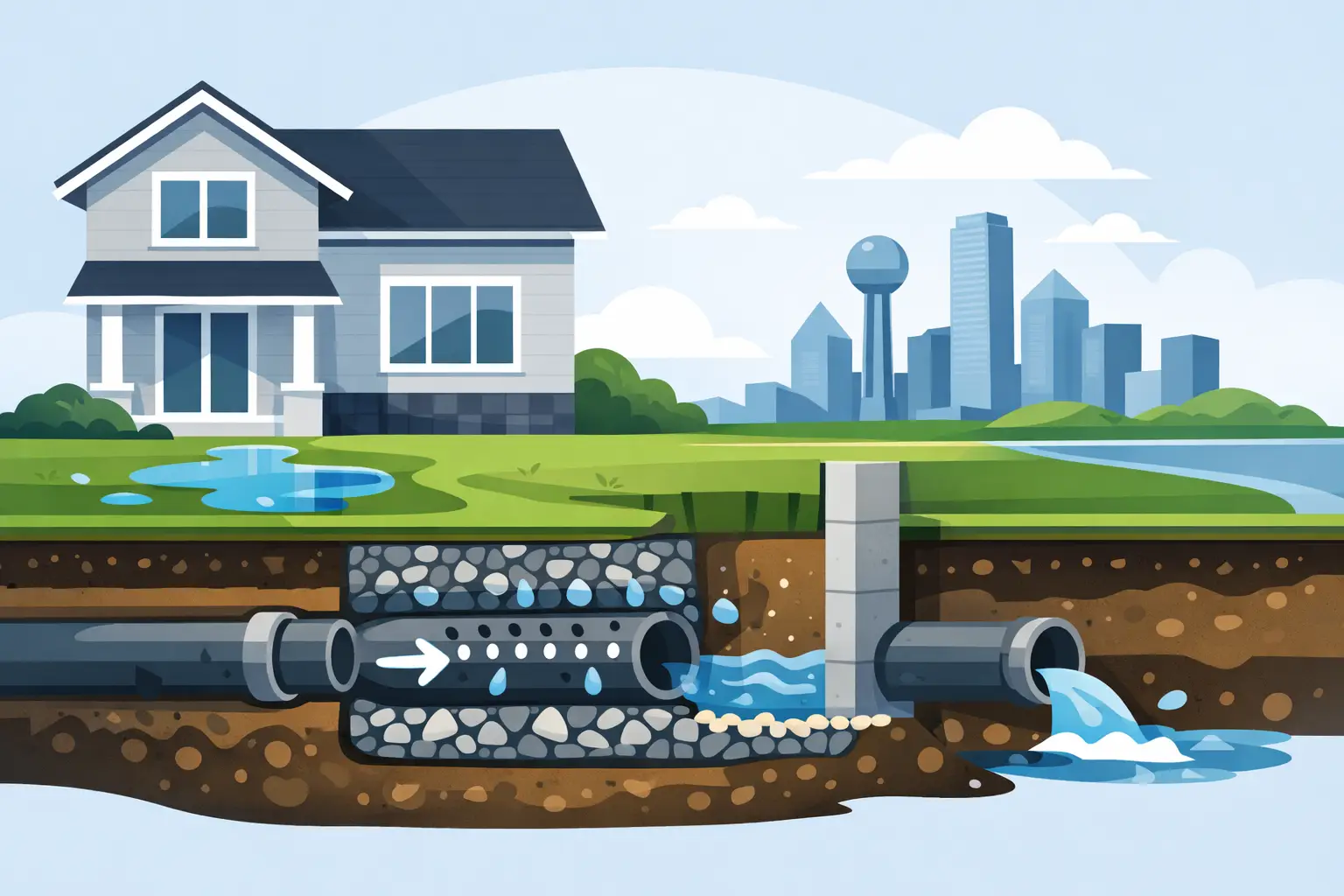
A French drain is a buried drainage system that collects water from saturated soil and directs it away from an area where it can cause trouble. Most systems include a trench, gravel, a perforated drain pipe, filter fabric, and a path for the water to exit safely. Water enters through the gravel and openings in the pipe, then follows the pipe’s slope toward a discharge location.
Despite the name, a French drain is not a one-size-fits-all solution. The pipe location, trench depth, slope, gravel size, fabric, and outlet all affect whether the system works over the long term. A drain that has no reliable place to discharge water is not a complete drainage plan. It may collect water, but it cannot solve the underlying problem if that water is allowed to empty near the foundation, onto a neighbor’s property, or into an area that floods.
The goal is straightforward: collect excess subsurface water before it can remain against the home and move it to an approved area where it will not create a new issue.
When French Drains Make Sense
French drains are especially helpful when water is moving through the soil rather than simply flowing across the surface. For example, a home may sit below a neighboring property, receive runoff from a sloped yard, or have landscape beds that hold water beside exterior walls. A French drain can intercept that underground moisture and redirect it before it reaches the foundation area.
Common signs that a property may benefit include consistently wet soil near the house, standing water that returns after rain, erosion along a side yard, water entering a crawl space, or moisture collecting behind a retaining wall. Foundation warning signs such as new interior cracks, exterior brick cracks, sticking doors, and uneven floors also deserve attention, particularly when they appear alongside poor drainage.
Still, not every wet yard needs a French drain. If rainwater is visibly running across the lawn and pooling because a gutter downspout dumps water beside the house, a surface drain, downspout extension, grading correction, or catch basin may be the better answer. In many cases, the strongest plan uses more than one method. Surface drainage handles water above ground, while a French drain addresses water held below the surface.
A proper inspection should identify where water begins, how it travels, and where it can safely go. Installing a drain without understanding those details can waste money and leave the foundation exposed to the same moisture pattern.
Why Drainage Matters to North Texas Foundations
North Texas expansive clay soil is not stable at a fixed moisture level. During wet weather, it can swell. During prolonged heat and drought, it can shrink and pull away from parts of the foundation. When one side of a home stays wetter than the other, the soil can move unevenly.
That does not mean drainage alone causes every foundation problem or that a French drain can repair existing structural damage. Foundation movement may involve several factors, including plumbing leaks, tree roots, poor site grading, construction conditions, and long-term soil behavior. But controlling excess water is often a critical part of protecting a repaired foundation and helping prevent moisture-related movement from continuing.
This is why drainage should be treated as part of a complete property evaluation, not as an afterthought. A homeowner who repairs foundation damage but continues to allow roof runoff and saturated soil to collect near the slab may be leaving an important risk unaddressed.
What a Lasting French Drain Installation Requires
A durable system starts with a plan based on the actual conditions of the property. The contractor should evaluate the home’s elevation, yard slope, existing drains, downspout locations, landscaping, soil conditions, and the direction water takes during a storm. It is also necessary to locate utilities before excavation begins.
The trench must have enough slope for water to move consistently toward its outlet. Too little slope can cause water and sediment to sit in the pipe. Too much slope can allow water to move quickly while leaving heavier material behind. The right approach depends on the run length, elevation changes, and the location of the discharge point.
Quality materials matter as well. Filter fabric helps separate the gravel from the surrounding soil so fine clay particles are less likely to clog the system. Proper gravel promotes water flow around the pipe. The pipe must be sized and positioned correctly, with cleanouts or access points included when appropriate for future maintenance.
The outlet deserves the same attention as the collection area. Depending on the site, water may discharge to a safe daylight outlet, a curb connection where permitted, a drainage easement, or another approved destination. Local rules and site limitations matter. Water should never be directed in a way that damages another structure, overwhelms a neighboring yard, or creates a hazardous wet area.
Landscaping also needs to be restored thoughtfully. A drainage project may require removing portions of sod, edging, shrubs, or decorative rock. The best installation balances drainage performance with a finished appearance that respects the homeowner’s property.
Maintenance Is Usually Simple, but It Still Matters
French drains are largely hidden, which makes them convenient but easy to forget. Periodically inspect the outlet after a heavy rain to confirm water is moving freely. Keep outlet areas clear of leaves, mulch, soil, and overgrown vegetation. If cleanouts are present, they can be used to inspect or flush the line if reduced flow becomes a concern.
Avoid driving heavy equipment over shallow drainage runs unless the system was designed to handle that load. Be careful when adding trees, shrubs, or new landscape beds, since roots and changes to grading can affect drainage performance over time.
If pooling returns, do not assume the entire system has failed. The issue could be a blocked outlet, damaged pipe, changed grade, gutter overflow, or a new source of water entering the yard. A professional evaluation can pinpoint the cause before a small correction becomes a larger excavation project.
French Drains and Foundation Repair: The Right Order
Homeowners often ask whether drainage should be completed before or after foundation repair. The honest answer is that it depends on the property and the repair plan. When severe drainage problems are actively saturating the soil around the home, correcting them early may be necessary to stabilize site conditions. In other situations, foundation repair and drainage correction are coordinated as parts of the same long-term plan.
The key is not to treat them as unrelated projects. A foundation repair plan should consider moisture management, and a drainage plan should account for the structure it is protecting. This is particularly true for homes with prior movement, active cracks, or a history of water collecting along one side of the building.
At All American Foundation Repair & Drainage, LLC, inspections focus on practical solutions for the conditions found at your property. Homeowners deserve a clear explanation of what water is doing, whether a French drain is the right tool, and what other repairs or drainage improvements may be needed to protect the home.
If your yard stays wet long after a storm or water repeatedly gathers near the foundation, take a walk around the property during the next rainfall. Notice where the water starts, where it settles, and where it has nowhere to go. Those observations can help turn an anxious guess into a clear plan for protecting your home.