Are French Drains Worth It for DFW Homes?
November 13, 2026
A French drain is not a decorative landscaping upgrade. It is a water-control system designed to keep recurring moisture away from your foundation, crawl space, or low-lying yard. So, are French drains worth it? For many Dallas-Fort Worth property owners, the answer is yes – but only when the drain is designed for the actual source and path of the water.
A drain installed in the wrong location can leave you with the same puddles, wet soil, and foundation concerns you had before. A properly planned system, however, can reduce one of the biggest contributors to foundation movement in North Texas: uneven moisture in expansive clay soil.
Are French Drains Worth It for Foundation Protection?
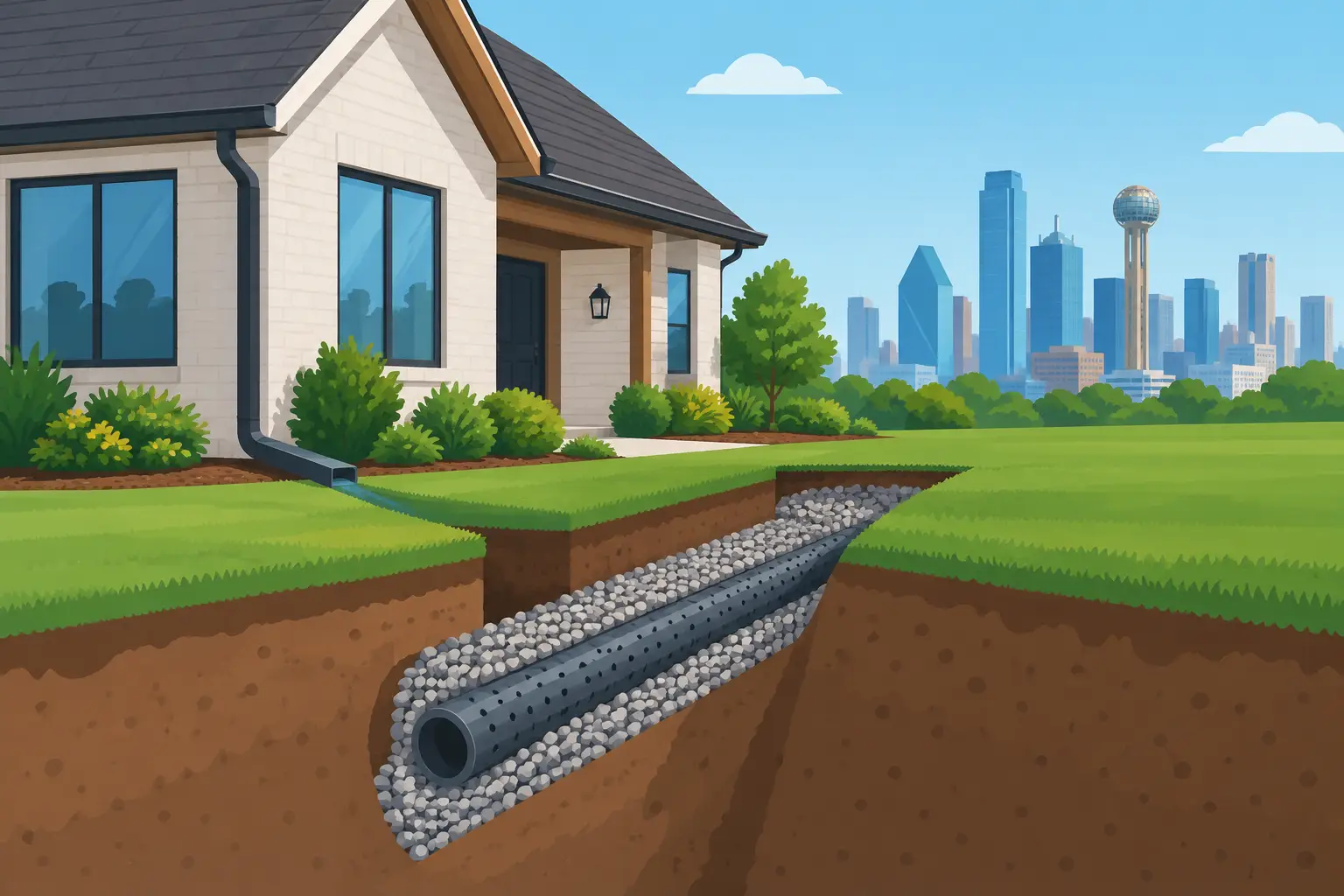
French drains can be worth the investment when water repeatedly collects near the home, flows toward the foundation, or keeps parts of the soil much wetter than others. The system generally consists of a perforated pipe set in a gravel-filled trench. Water enters through the gravel, reaches the pipe, and is carried to a suitable discharge point away from the structure.
The purpose is straightforward: control water before it has time to saturate the soil beside your foundation.
In the Dallas-Fort Worth area, that matters because clay-rich soils expand when wet and shrink during dry periods. When one side of a foundation stays wetter than another, the soil may not support the slab evenly. Over time, that uneven movement can contribute to cracks in brick or drywall, sticking doors, uneven floors, and gaps around windows.
A French drain does not repair a foundation that has already moved. It can, however, be an important part of protecting a repaired foundation or reducing the moisture conditions that may contribute to additional movement. Think of it as prevention and moisture management, not a substitute for structural repair when structural repair is needed.
When a French Drain Makes Good Financial Sense
The best reason to install a French drain is not simply that your yard gets muddy after a storm. It is that water is creating a repeated risk around your property. Homeowners often see the value when the system solves a persistent condition rather than a one-time drainage inconvenience.
A French drain is often a good fit when runoff from a neighboring property reaches your yard, a sloped lot sends water toward the house, or a low area stays saturated long after rain has stopped. It can also help when downspout water is properly directed into a drainage plan but needs an underground route to a safe outlet.
It may be especially worthwhile if you have already noticed early warning signs around the home. These can include soil pulling away from the foundation during dry weather, standing water near the slab after rain, dampness in a crawl space, musty odors, or recurring erosion along the perimeter. Addressing drainage before those conditions lead to larger repairs can protect both your home and its resale value.
For commercial properties, the same principle applies. Water that ponds near building edges, sidewalks, loading areas, or lower elevations can affect more than appearance. It can create safety concerns, damage landscaping and pavement, and add stress to structural systems over time.
When Another Drainage Solution May Be Better
A French drain is effective, but it is not the right answer to every wet-yard problem. Surface water needs to be handled at the surface first when possible. If rainwater is flowing across a driveway or collecting in a broad, shallow low spot, a surface drain or catch basin may capture it more directly than a French drain.
Likewise, gutters and downspouts should not be overlooked. A clogged gutter or a downspout that empties beside the foundation can release a surprising amount of water into one small area. Extending downspouts, correcting grading, or adding a surface drainage system may solve the problem with less excavation.
French drains also require a place for water to go. The pipe needs sufficient slope and a legal, practical discharge point. A system cannot simply collect water underground and leave it trapped near the house. That is why a drainage inspection should consider the entire property, including lot grading, roof runoff, neighboring drainage patterns, soil conditions, utilities, and available outlets.
In some cases, the strongest plan uses more than one solution. For example, surface drains can collect fast-moving runoff while a French drain handles water soaking into the soil along a foundation wall. The right design depends on how water behaves on your property, not on which drainage term sounds most familiar.
What Affects the Cost and Value of a French Drain?
French drain pricing varies because every property presents different access, depth, routing, and discharge challenges. A short run through open landscaping is a very different project from a deep system that must work around patios, fencing, trees, utility lines, or a tightly confined side yard.
The quality of installation also affects long-term value. Proper pipe selection, trench depth, gravel placement, filter fabric, cleanouts, slope, and outlet design all matter. Cutting corners can lead to sediment buildup, crushed pipe, poor flow, or water that returns to the same area it was meant to leave.
Before approving a proposal, ask what problem the recommended system is intended to solve and where the captured water will discharge. You should also understand whether landscaping, irrigation, concrete, or other site features will need to be disturbed and restored. Clear answers help you compare proposals based on performance, not just the lowest initial price.
For homeowners concerned about budget, it is also worth weighing drainage work against the cost of waiting. Persistent moisture problems can worsen landscape erosion, damage hardscape, invite pests, create crawl space moisture issues, and contribute to soil movement around a foundation. A drainage improvement may be a more manageable investment when completed before damage becomes extensive.
Signs You Should Schedule a Drainage Evaluation
You do not need to diagnose the solution yourself. You do need to pay attention to patterns. If water consistently collects against the house, if one area of the yard never dries, or if runoff from a heavy storm follows the same path toward your foundation, it is time for a professional evaluation.
Foundation symptoms deserve attention as well. New or widening cracks, doors that begin to stick, floor changes, and separation at trim or exterior brick can have several causes. Drainage is not always the only issue, but it should be part of the conversation, particularly in North Texas where soil moisture changes can be significant.
A thorough inspection should separate the structural question from the drainage question while recognizing that they are often connected. The goal is not to sell a drain where one is unnecessary. The goal is to identify how water is affecting the property and recommend a practical, long-term plan.
Choosing a Drainage Contractor in Dallas-Fort Worth
Look for a contractor with local experience in foundation behavior as well as drainage installation. Water management should be planned with the foundation in mind, especially for slab homes built on expansive soils. Ask whether the recommendation accounts for the grade around the home, existing foundation conditions, and where the system will move water after collection.
At All American Foundation Repair & Drainage, LLC, we have worked with North Texas homeowners and property owners since 1969. Our approach is to inspect the conditions on site, explain what we see in plain language, and recommend drainage or foundation work that fits the property rather than a one-size-fits-all package.
A French drain is worth it when it resolves a real water problem, protects vulnerable soil around your foundation, and sends water where it can safely drain away. If recurring moisture has you watching the forecast or worrying about the next crack, a professional assessment can replace guesswork with a plan built for your property.